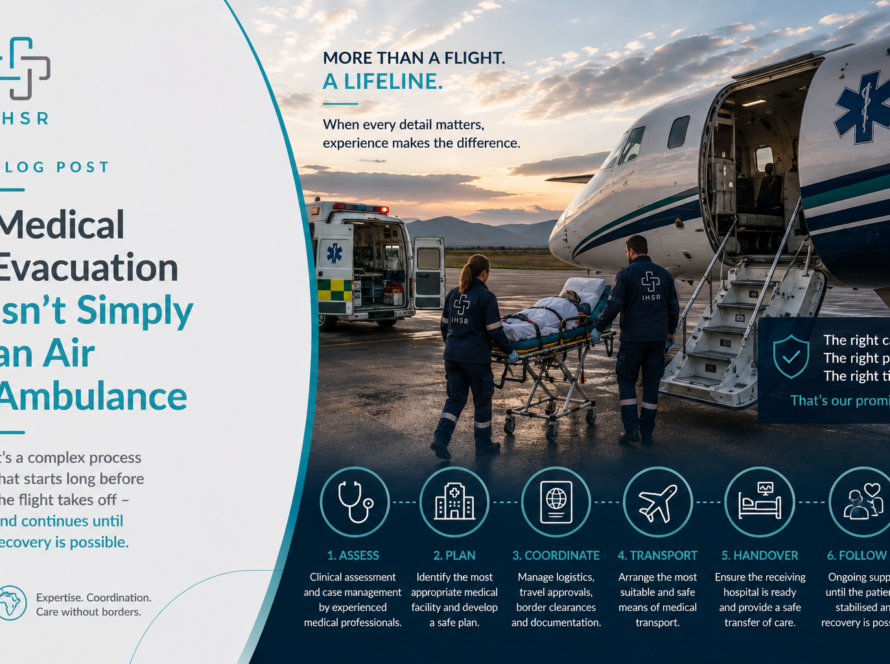
When an employee becomes seriously ill or injured while working abroad, access to healthcare becomes more than a medical consideration. It becomes a logistical one.
This is particularly relevant across parts of Africa, where employees may work in mining, construction, agriculture, tourism, infrastructure and other industries far from major medical centres.
A patient may be close to a hospital, but that hospital may not have the specialist facilities required to manage their condition.
A real example: a cardiac emergency in Kariba
It is late afternoon in Kariba. A 54-year-old man collapses with severe chest pain. The local doctor suspects a major cardiac event.
The nearest tertiary cardiac unit is across a border. The situation is time-sensitive.
While the patient is being stabilised, case management begins coordinating with the treating doctor. ECG results are reviewed, blood markers are discussed and the patient’s stability is assessed.
A decision is made that evacuation is medically necessary, but the evacuation does not simply involve finding an aircraft.
At the same time:
- Aircraft availability is confirmed.
- Crew is mobilised.
- Flight planning begins.
- Cross-border clearance is requested.
- A receiving hospital bed is secured.
- A cardiology team is alerted.
- Weather is reviewed.
- Airspace permissions are obtained.
- Fuel requirements are calculated.
All of this happens while the patient is being treated and the family waits for news.
Medical evacuation is a coordinated medical intervention
One of the most common misconceptions is that medical evacuation means putting a patient onto an air ambulance and flying them to their preferred destination.
It doesn’t work that way.
The evacuation decision is clinically led. It considers whether the patient has a life-threatening or limb-threatening condition, whether appropriate treatment is available locally and whether transfer is medically necessary.
The destination is also determined by clinical suitability. That may mean the nearest appropriate specialist centre rather than the patient’s home country.
Air is not always the answer
Medical evacuation can involve much more than aircraft. Depending on the circumstances, medical assistance teams may coordinate:
- Long-distance road transfers
- Cross-border ambulance transfers
- Fixed-wing air ambulance transfers
- Helicopter transfers
- Commercial flights with medical escorts where appropriate
- Neonatal retrievals
- Specialist cardiac transfers
- Stroke transfers
- Remote trauma extraction
International Health & Speciality Risks documented experience includes evacuations and transfers in Africa specifically, involving Zimbabwe, Zambia, Malawi and South Africa, as well as remote areas such as Kariba, Victoria Falls, Lupane and the Zambezi Valley.
Why this matters to employers
For organisations sending employees into remote locations, medical planning should form part of the broader risk assessment.
Questions worth asking include:
- Where is the nearest appropriate medical facility?
- What specialist treatment is available locally?
- How long would it take to reach an appropriate facility?
- What happens if cross-border treatment is required?
- How would an evacuation be coordinated?
International medical insurance can form part of this risk-management strategy, depending on the policy, benefits and circumstances.
The important point is that healthcare risk should be assessed before an employee needs emergency assistance, rather than during the emergency itself.