Risk management often starts with a simple question:
What could go wrong?
For businesses operating internationally, that question can produce a long list.
- An employee could become seriously ill in a remote location.
- A traveller could suffer a major injury abroad.
- Political unrest could disrupt operations.
- A business could lose access to its premises.
- A supply chain could be interrupted.
- A contractor could require emergency medical assistance far from a major healthcare centre.
Insurance has an important role in these scenarios, but it should not necessarily be the first step in the conversation.
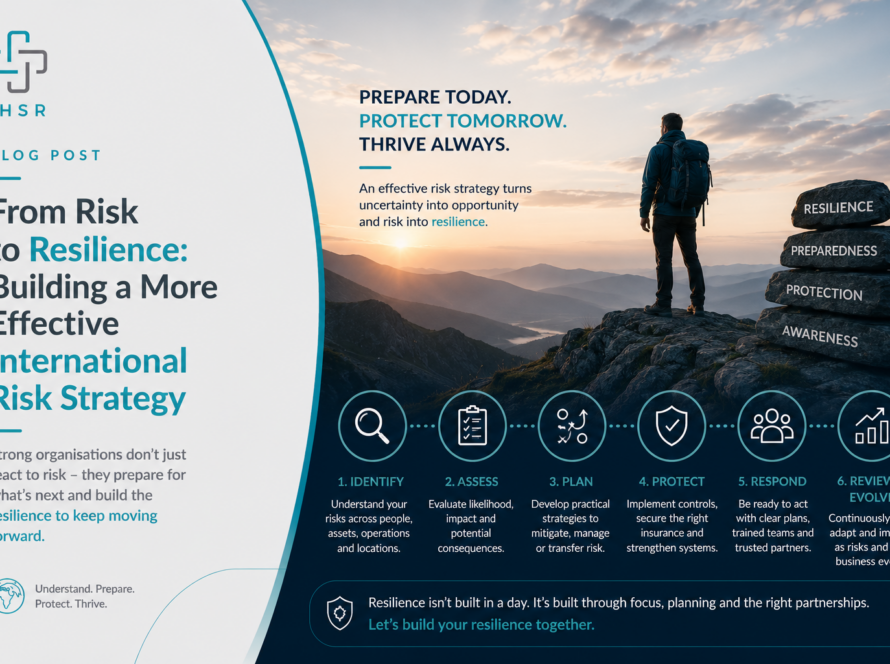
Step 1: Identify the risk
Start by understanding the environment.
- Where are your employees?
- Where are your assets?
- What activities are being undertaken?
- How remote are the operations?
- What healthcare is available?
- What political or security risks exist?
Step 2: Assess the consequences
Identifying a risk is not enough. You also need to understand what happens if it occurs.
Could it result in:
- Medical expenses?
- Evacuation?
- Business interruption?
- Property damage?
- Employee disruption?
- Supply-chain disruption?
- Reputational consequences?
Step 3: Decide how the risk should be managed
Different risks require different responses. A business may choose to:
- Avoid a risk
- Reduce the likelihood of an event
- Reduce the impact
- Transfer part of the financial exposure
- Accept a manageable risk
Insurance is generally most useful as part of the risk-transfer component.
Step 4: Understand the insurance solution
This is where specialist advice becomes important. For example:
- International health insurance may help address international healthcare costs and access, subject to policy terms.
- Travel insurance may address specified travel-related risks.
- Political Violence & Terrorism insurance may address specified political violence exposures.
- Medical evacuation benefits may provide access to coordinated medical transfer where the clinical and policy requirements are met.
But none of these should be considered without understanding the underlying exposure.
Step 5: Review regularly
- Risk changes.
- An organisation may expand into a new country.
- A new project may take employees into a remote location.
- Asset values may increase.
- Political conditions may change.
- Supply chains may become more exposed.
- An employee’s circumstances may change.
The insurance programme should therefore be reviewed when the risk profile changes, not simply when the renewal date arrives.
The role of a specialist broker
A broker’s role is not simply to find a policy. It is to help understand the exposure, identify appropriate insurance solutions and navigate the complexities of the insurance market.
For specialist risks, that can be particularly important because the right solution may depend on details that are not immediately obvious. Insurance should support risk management — not replace it
The strongest risk strategy is not:
“We have insurance, so we’re covered.”
It is:
“We understand our risks, we have plans to manage them, and we’ve considered where insurance can help transfer the financial consequences.”
That is a much more resilient approach to international risk.